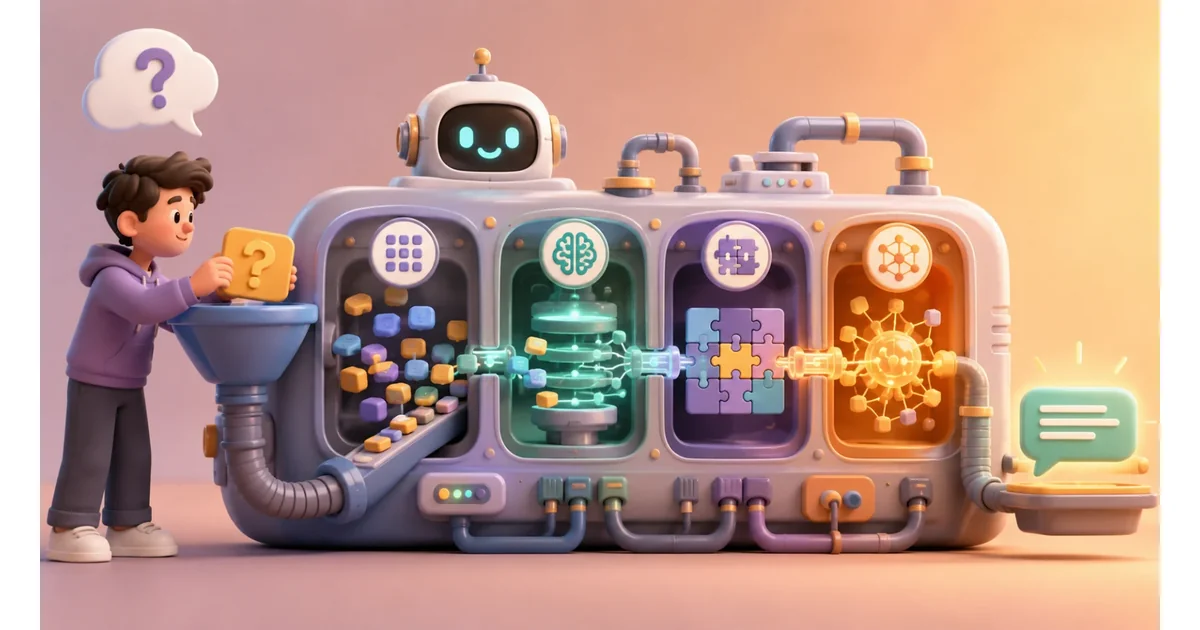
Focus Keyword: What happens when you ask ChatGPT a question
SEO Title (56 characters): What Really Happens When You Ask ChatGPT a Question?
Meta Description (155 characters): Wondering what happens when you ask ChatGPT a question? Learn how prompts, tokens, context windows, and next-token prediction work in simple terms.
Every day, millions of people ask ChatGPT questions.
"Write a Python function."
"Explain quantum physics."
"Plan my vacation."
"Debug this error."
The answer usually appears within a few seconds.
It feels almost magical.
But what actually happens behind the scenes?
Does ChatGPT search the internet?
Does it understand what you're thinking?
Does it have a giant database of answers?
Not exactly.
Let's follow your question from the moment you press Enter until the answer appears on your screen.
# Step 1: Your Question Arrives
Imagine you type:
"Explain Python decorators with an example."
To you, that's one sentence.
To ChatGPT, it's simply raw text.
Before the AI can understand anything, it has to convert your sentence into a format computers can process.
That brings us to the first important concept.
# Step 2: Your Question Is Broken Into Tokens
Humans read words.
LLMs read tokens.
A token is a small piece of text.
For example, this sentence:
Explain Python decorators with an example.
might become something like:
Explain
Python
decorators
with
an
example
.
Different AI models split text differently.
Sometimes a single word becomes multiple tokens.
For example:
unbelievable

↓

un
believ
able
Even programming code becomes tokens.
print("Hello")
might become:
print
(
"
Hello
"
)
Everything the AI reads—including text, code, punctuation, and numbers—is converted into tokens first.
# Step 3: Everything Is Added to the Context Window
This is one of the biggest misconceptions about ChatGPT.
It doesn't only look at your latest message.
It also looks at:
your current question
previous conversation
custom instructions (if any)
uploaded files
system instructions
All of this is placed into something called the context window.
Think of the context window as the AI's short-term memory.
If the model supports 128,000 tokens, then everything—your question, previous messages, and the AI's reply—must fit inside those 128,000 tokens.
If the conversation becomes too long, older information eventually falls out of the context window.
That's why AI sometimes forgets details from much earlier in a conversation.
Memory in AI Agents: Vector DB vs Structured State (and When to Use Both)
# Step 4: A Hidden Prompt Is Built
Here's something many people don't realize.
The message you type is not the only thing sent to the model.
Behind the scenes, the application builds a much larger prompt.
A simplified version might look like this:
System Instructions:
You are a helpful AI assistant.

Conversation History:
...

User:
Explain Python decorators with an example.
In enterprise AI systems, this prompt can become much larger.
It may also include:
company documents
retrieved RAG context
chat history
formatting instructions
safety rules
This process is called prompt building.
Your message is only one part of the final prompt.
# Step 5: The Model Starts Predicting the Next Token
Now comes the most surprising part.
ChatGPT does not write complete sentences.
It doesn't generate entire paragraphs at once.
Instead, it predicts one token at a time.
Imagine the prompt ends with:
Python decorators are
The AI calculates the probability of thousands of possible next tokens.
Maybe something like:
used → 62%
functions → 18%
special → 9%
created → 4%
It chooses one.
Now the sentence becomes:
Python decorators are used
Then it repeats the process.
Again.
And again.
Thousands of times.
This happens so quickly that it appears as if the model is writing continuously.
In reality, it's making thousands of tiny predictions every second.
This process is called next-token prediction.
Generative AI Roadmap: A Practical, Beginner-Friendly Guide to Learning and Building Real Projects
# Step 6: Temperature Affects the Choice
If you've ever noticed ChatGPT giving different answers to the same question, temperature is often one reason.
A low temperature makes the AI choose the most likely next token.
That leads to:
more consistent answers
factual responses
reliable code generation
A higher temperature introduces more randomness.
That's useful for:
storytelling
brainstorming
creative writing
Most coding assistants use a relatively low temperature because accuracy is more important than creativity.
# Step 7: The Response Streams Back to You
As each token is generated, it's immediately sent back to your screen.
That's why you see the response appear word by word instead of waiting for the entire answer.
From your perspective, it feels like the AI is typing.
Behind the scenes, it's simply streaming newly generated tokens as soon as they're predicted.
# What About Internet Search?
Another common misconception is that ChatGPT searches Google every time you ask a question.
It doesn't.
Unless a chat explicitly uses web browsing or a search tool, the model answers using:
what it learned during training
the information inside the current context window
any documents or files provided in the conversation
That's why Retrieval-Augmented Generation (RAG) is so important in enterprise applications.
Instead of relying only on pre-trained knowledge, the AI first retrieves relevant company documents and adds them to the prompt before generating an answer.
# So, Does ChatGPT Actually "Understand" Your Question?
Not in the way humans understand language.
ChatGPT doesn't think.
It doesn't reason like a person.
It predicts the next most likely token based on patterns learned from massive amounts of text.
Yet those predictions are so good that they often feel like genuine understanding.
That's what makes modern large language models so impressive.
# The Big Picture
Every time you ask ChatGPT a question, the same sequence happens:
Your question is converted into tokens.
Those tokens are placed into the context window along with previous conversation.
A complete prompt is built behind the scenes.
The model predicts the next token.
It repeats that prediction thousands of times.
The generated tokens are streamed back as the final response.
It all happens in just a few seconds.
# Final Thoughts
The next time you use ChatGPT, remember that there isn't a giant database of pre-written answers waiting behind the curtain.
Instead, every response is created from scratch, one token at a time.
Understanding what happens when you ask ChatGPT a question also helps explain why concepts like tokens, context windows, and prompt engineering matter so much.
Once you understand these building blocks, many AI concepts suddenly become much easier to grasp.
And that's the difference between simply using AI—and understanding how it really works.
# Key Takeaways
ChatGPT first converts your question into tokens.
Everything in the conversation is placed into a context window.
Your message becomes part of a larger prompt.
The model generates responses using next-token prediction.
The answer is streamed back to you one token at a time.
Understanding what happens when you ask ChatGPT a question makes it easier to understand modern AI systems and build better prompts.